

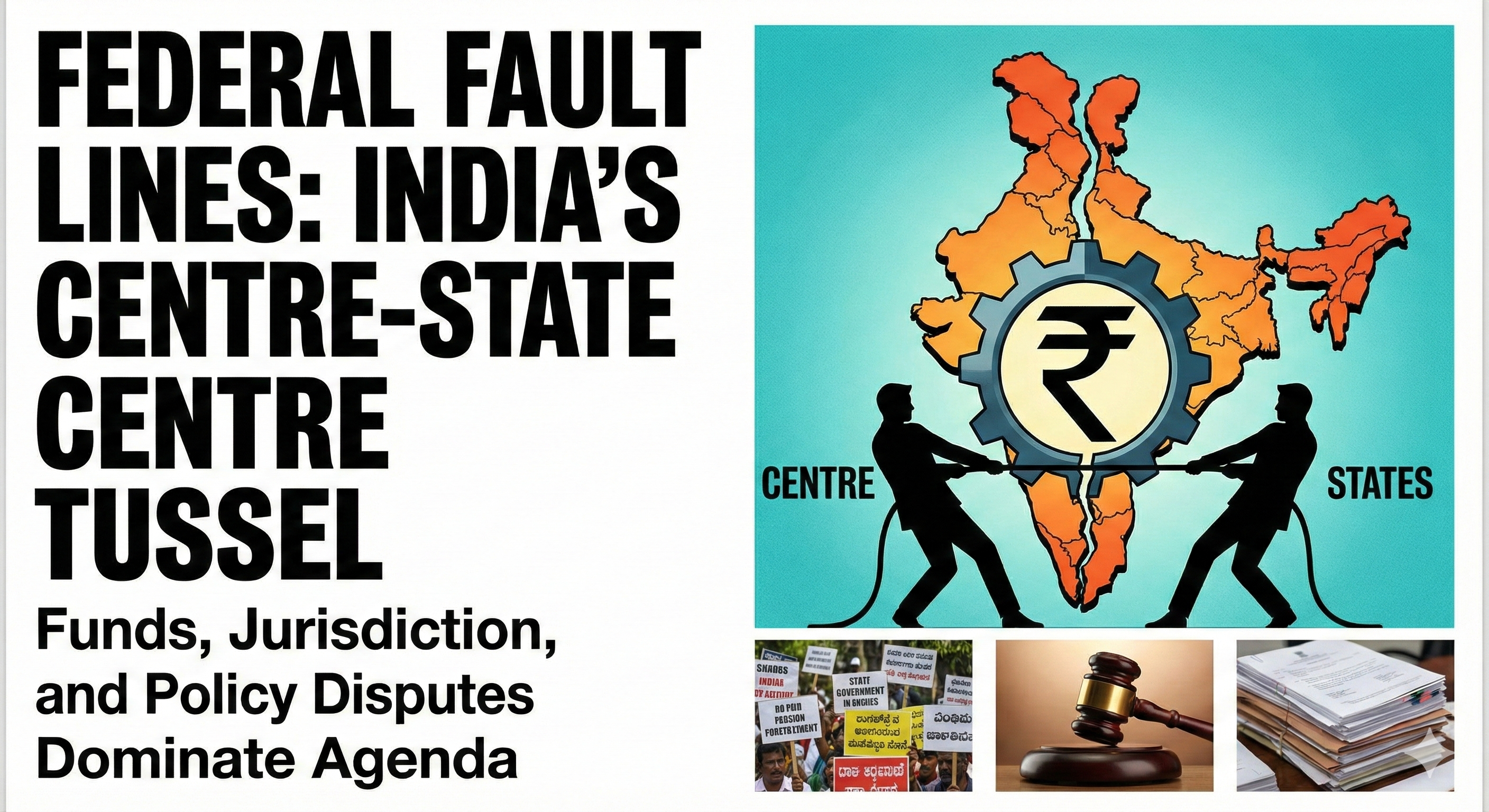
Federalism and Centre-State Tensions in India: Funds, Jurisdiction, and Policy Disputes

Social Justice Desk
India's federal system is rooted in constitutional division of power, but recent years have seen intensifying tensions between the Centre and opposition-ruled states—most acutely over financial allocation, legislative jurisdiction, and key policy directions.
Constitutional Framework and Power Sharing
Indian federalism divides legislative, executive, and financial functions between the Centre and states, aiming for a cooperative system. However, the framework grants significant supremacy to the Centre, especially in legislative and financial matters. Laws passed by Parliament in the concurrent list override state legislation, and the Governor, appointed by the President, is often perceived as an instrument of central influence in state governance.
Legal Pillars of Federal Friction
Disputes Over Funds
Disaster Relief Funds: In 2025, opposition-ruled states such as Karnataka and Tamil Nadu approached the Supreme Court, accusing the Centre of withholding disaster relief funds and showing "step-motherly treatment" in releasing financial assistance. Such disputes are frequent, especially when state and central governments belong to different parties.
"Accusing the Centre of withholding disaster relief funds and showing 'step-motherly treatment' in releasing financial assistance."
(2025) SC Petitions on Fund Withholding : 2 Key States
GST and Tax Sharing: Though the Goods and Services Tax (GST) streamlined revenue collection, many states raise concerns over delays in compensation payouts and the criteria used for revenue sharing by central Finance Commissions. Economic Planning and Resource Control: Economic planning in India has progressively favoured centralisation, with transfer of industry and policy control from the State List to the Union List, reducing state autonomy in crucial areas.
Jurisdiction and Legislative Clashes
Central Laws Challenged: Kerala and Chhattisgarh have approached the Supreme Court challenging central laws like the Citizenship Amendment Act (CAA) and the National Investigation Agency (NIA) Act, alleging that these infringe upon their legislative powers and disrupt social harmony.
Central Laws Challenged by States
Citizenship Amendment Act (CAA)
Challenged by Kerala and Chhattisgarh.National Investigation Agency (NIA) Act
Alleged infringement on state legislative powers.Delays in State Legislation: The Centre holds significant discretion over assent to state bills. For example, crucial laws like the Gujarat Control of Organised Crime Act (GUJCOCA) faced years-long delays by the President, which critics claim is politically motivated. Imposition of President’s Rule: Article 356 allows the Centre to dismiss state governments when constitutional machinery "fails," used more frequently for political reasons than genuine breakdowns, deepening mistrust.
Example of Legislative Friction
GUJCOCA Bill
Gujarat Control of Organised Crime Act faced 'years-long delays' in Presidential assent, highlighting discretionary power of the Centre over state legislation.
Policy Tensions and Opposition-Governed States
Delimitation and Census: Leaders like Mayawati have highlighted how disputes regarding Lok Sabha seat reallocation, census policies, and education reforms become tools for political gain rather than genuine cooperation.
States Resisting Central Policies
National Education Policy (NEP)
Resisted by states like Tamil Nadu and Maharashtra."Hindi Imposition"
Viewed as undermining regional identity and autonomy.Education and Language Policies: States such as Tamil Nadu and Maharashtra have resisted central imposition of the National Education Policy and "Hindi imposition," viewing such steps as undermining regional identity and autonomy. Governor-State Government Conflicts: In states ruled by opposition parties (Kerala, Tamil Nadu, Telangana), the post-2014 appointment of Governors by the Centre has escalated conflict, with state leadership accusing them of partisan interference in day-to-day governance.
The Triad of Federal Conflict
This chart illustrates the relative focus of the Centre-State tensions discussed in the article, with financial disputes over funds taking the largest share, closely followed by issues of legislative jurisdiction.
Judiciary's Role and Resolution Mechanisms
Article 131 Cases: The Supreme Court routinely adjudicates disputes under Article 131, which provides original jurisdiction over Centre-state conflicts, especially on questions of law, appropriation of funds, and jurisdiction. Presidential References: The Centre has sought judicial clarity on timelines for granting Governor and Presidential assent to state bills, reflecting increasing legal contention over administrative processes.
Sarkaria Commission’s Proposals
Experts recommend strengthening All-India Services and limiting central occupation of policy areas on the concurrent list to promote genuine consultation and reduce friction in federal relations.
Recommendations and Future Directions
Sarkaria Commission’s Proposals: Experts recommend strengthening All-India Services, limiting central occupation of policy areas on the concurrent list, and promoting genuine consultation in policy decisions to reduce friction. Cooperative Federalism: A return to cooperative federalism—rooted in respect, transparent sharing of resources, and dialogue—is essential for balancing national interests with state autonomy and development priorities.
India's federal system faces complex challenges as tensions over funds, jurisdiction, and policy deepen between the Centre and opposition-ruled states. The way forward lies in clarifying constitutional roles, enforcing transparent rules, and promoting meaningful intergovernmental cooperation to protect both national unity and regional diversity.
No comments yet. Be the first to share your thoughts!